
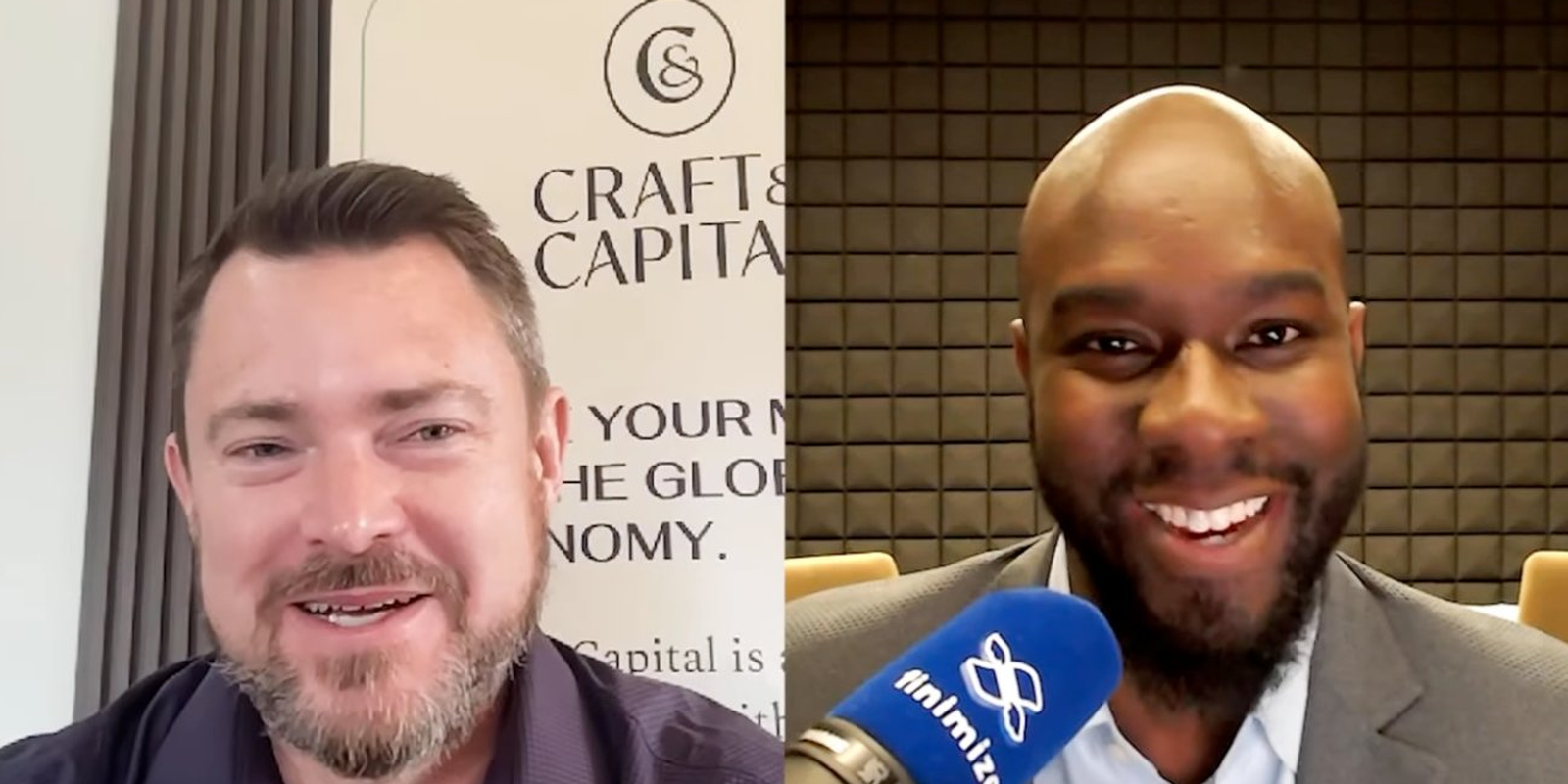
In this episode, I sat down down with Chris Sullivan, President of Craft & Capital – a New York-based, award-winning PR firm that specializes in helping financial services companies, from wealth managers to ETF issuers, build their brands and reach the right audiences.
With nearly 30 years in financial communications and 21 at the helm of Craft & Capital, Chris has watched the industry shift from a world of CNBC-and-Barron's monoculture to today's fragmented media landscape – and he has strong views on what that means for asset managers trying to gather assets.
The media landscape has fragmented – and that's an opportunity
Twenty years ago, a CNBC hit and a Barron's mention could anchor a quarter's PR strategy. Not anymore. Chris explains how earned media is now just the starting point: issuers also need to show up in the right newsletters, podcasts, trade publications and YouTube channels, backed by their own content. Audiences are dispersed, and trying to "be everywhere all at once" is a sign you're trying to do too much.
Self-directed retail is not a monolith
The biggest shift over the past five years is the rise of the self-directed retail investor – but Chris is quick to push back on the "dumb money" framing that still lingers in some corners of the industry. These are increasingly sophisticated investors using more tools than ever. The job for ETF issuers is to figure out which slice of that audience matches their product, then go meet them where they actually are.
Smaller audiences, bigger conversions
One of the more counterintuitive points Chris makes: a podcast or YouTube channel with 10,000–20,000 subscribers can outperform a mass-market placement if the community is engaged. Dedicated audiences are primed to act – and often already a few steps down the path of understanding what your product does.
Start the PR conversation before the product launches
Chris's playbook for new ETF launches starts well before the ticker goes live. The filing and regulatory review period is the time to sharpen positioning, develop spokespeople and lock in the narrative. His view: your strategy can't be your story. Even passive, index-driven products need a face, a personality and a why.
Why issues struggle: distribution, timing and narrative
When launches underperform, Chris sees three recurring culprits: bad luck on timing (a tough first month can take years to recover from), weak distribution in the wealth management channel, and a lack of clear narrative. The first is largely out of your hands. The second and third are not – and engaging self-directed retail becomes especially important when gatekeepers and asset thresholds slow down adviser access.
Tickers, time and the truth about overnight success
Catchy tickers help, but they're getting harder to come by – and they're not the whole story. Repetition, performance and being in the right channels turn tickers into brands over time. And speaking of time: most "overnight success" ETF stories took three or four years to materialize. Issuers who expect fast asset growth often aren't prepared for the long road that's actually required.
A bear market for trust
Chris closes on a theme that runs through the whole conversation: we're in a bear market for trust. The PR firms, platforms and spokespeople who lead with education – not product pitches – are the ones earning credibility with both journalists and investors. For ETF issuers, the lesson is clear: pick your channels carefully, invest in your people, and play the long game.
Grow your business
with Finimize
Our Partners



Full transcript
Carl: My guest today is Chris Sullivan. He's the president of Craft & Capital, a New York-based award-winning PR firm that specializes in helping financial services companies, from wealth managers through to ETF issuers. Chris, fantastic to have you. Thank you for joining me today.
Chris: Thank you for having me. And I have to say, the way you say "Craft & Capital" is so much better than the way I say it. I think we're going to need you to do some voiceover work for our website.
Carl: Well, you know where I am. I'm happy to. Welcome to Craft & Capital!
Chris: Yes, I'm sold. You're hired!
Carl: Boom! Okay, end the podcast. No – let's get right into it. Chris, you've been working in financial PR and comms for almost three decades. Not to age you, but maybe let's start by sharing a bit more background with our viewers and listeners. How did you get into the industry, and how has it changed since you started?
Chris: Yes, it's somehow almost 30 years that I've been doing this, and it's been 21 years here at Craft & Capital – which does age me as I hear myself say that out loud. Fundamentally, at the core of what we do, our mission is still the same. It's the tools that we have and all the channels we're able to access now that has really evolved, especially over the last five to six years.
We joke about it, but 20 years ago, you could get a client on CNBC, put a client in Barron's, and then kind of call it a quarter. You had really checked all the main boxes that people were looking for. Now those same boxes remain – they are important – but you also have to be on the podcast circuit. You have to be in the right newsletters, the right trade publications. You probably have to be producing your own content to go along with your earned media opportunities, because the audiences are so dispersed now. And there are so many different audiences our clients are trying to reach.
Carl: Wow. So it's new products, the proliferation of products, the proliferation of channels, and within channels the proliferation of publications or surfaces. It's not just CNBC and Bloomberg now – there are a hundred other channels trying to compete. It's not just "get on the newsletter," it's which newsletter, which audience.
Chris: And that's very important to us in terms of what we're doing, because we're not just trying to put clients in front of anyone. It has to be the right platform that's going to reach the right audience. For our ETF issuers, that can really range. Some of our clients are purely focused on self-directed retail, so we have to take that into account. Many of them – and this goes back 20 years ago when we started in ETFs – are focused on the wealth manager channel, the financial advisors. That's who they want to speak to.
More and more, we have clients that would like to speak to institutional investors. There's a very different approach and a very different universe of platforms and outlets when you're talking about all of those different cohorts of investors.
And for a lot of our clients, they want all three and more. So we have to take that into account and not just blast people out there into the ether and hope for the best. You have to have a strategy. You have to have a plan. You have to know where the audiences are and who they are, to make sure you're working with the right platforms to make a difference for your clients.
Carl: Okay, so let's get into that a little bit. At the top you said your mission hasn't changed, but how you achieve it has. It sounds like what your clients are asking of you has changed. Maybe just talk me through a little of that.
Chris: Yeah, I would say fundamentally what our clients are looking for is growth, and PR communications is a key part of any client's growth engine. It's about getting the brand out there, getting the people out there, the ideas out there – for ETF providers, the tickers, the investment thesis out there. But yes, definitely what has changed is all the ways we're able to go about that.
We still have the old-school press releases and pitching, which we still do – still very important to what we're doing. But there are a lot of different ways now that we're able to research and figure out who these investors are, what they're looking for, what they're asking about. We can go on different platforms. We can work with a Finimize, which has great data and insights into its audience that can be very telling for us – that X percent of investors are very concerned about income but don't feel like bonds are quite doing it for them. What do we take away from that? How can we help position fixed-income managers in a world like that? And how can we help other managers that maybe have different income-driven approaches play into that narrative and make sure their voice is really shining through?
The evolution has really been something, and so much of it is technology-driven. But I always remind people that at the heart of all that technology, and really wrapped up in all those tools we're using, at the end of the day it's a person – it's a group of people on the other side of all of this that we're trying to connect with. We're trying to give them ideas. We're trying to spur them to action. You can't forget the people in public relations; without them, there's not much going on. So what's really changed are the tools and the platforms we're able to use.
Carl: Gotcha. One of the things we're talking around already is – rewind 20 years to when you started Craft & Capital, there was a bit of a monoculture, right? It's Barron's, it's CNBC, just to pick those two examples. And now you've got a multiculture. How do you adapt, or did you adapt, with the challenge of having to be everywhere all at once? For you, you have to be across it all for your clients.
Chris: I think in some ways you kind of answered your own question, because you don't actually have to be everywhere all at once. And if you think about this through the lens of "I have to be everywhere all at once," you're probably trying to do too much.
In a situation like that, I would actually rewind a bit. Let's say we're talking about an ETF provider, ETF issuer. I would go very back to the very beginning with the product or products in question. I would want to dig into: what is the utility here? What are the use cases? What is this designed to provide? What issue is this designed to solve? As portfolios are evolving and people are looking at the world right now and all the volatility going on, how does this help those investors? You start with that, and you can start to narrow down the universe. Okay, who am I trying to reach?
One of the biggest changes – and we've started talking about this a little bit – is that rise of the self-directed retail investor.
Carl: Yeah.
Chris: Understand that's not a monolith. That is not a group that has universal concerns or universal needs. There are so many offshoots and splinters in the conversations going on within that self-directed retail channel. It's almost infinite when you think about everything being discussed. So you can spend a lot of time being part of conversations that probably don't actually help you or your brand all that much.
So it's really important to understand: what is our use case? What is our mission? And then figure out who specifically is the audience for that. Then you can start to drill down and figure out: what are the newsletters? What are the TV shows? What are the YouTube channels? What are the podcasts? Where should I actually be? Where those people who care about this topic – or who should care about this topic – are coming together to try to figure this out as a group. That's where you want to be, because that's what's going to be meaningful for your brand and, candidly, for gathering assets, because you're going to be talking to the right people.
Carl: Yeah, 100%. You talked about retail investors not being a single audience and having varying needs, varying targets, varying approaches. And one thing – not to get on my soapbox – but one thing that is really annoying is how much media describes retail as dumb money, last to the party, meme stock traders who can only see as far as the next GameStop. Our data time and time again shows that just isn't the case. Proven that as many times as you care to count, I guess.
Maybe a bit of inside baseball, but are those sorts of conversations you have with your clients? Do you get push-back when you say, "Actually, this new channel, this new form of media is where the conversation you need to be a part of is"? And do you get push-back like, "Uh, that's dumb money, they only care about memes"? Or is that just the media?
Chris: No, there's a lot to unpack in there. I would just start by saying I completely agree with you. I cringe at the "dumb money" descriptor. Thankfully, I think we are moving past that in terms of the discourse around retail investors, because it's not true. These are more and more sophisticated people who are taking the time and leveraging all the tools at their disposal now to really learn about what's out there and what could be meaningful for them. So anyone using the term "dumb money" is years behind what's actually happening.
Carl: They themselves are dumb for using that term.
Chris: Hey, you know what? There's another one. You're hired, you're coming on board to help us with taglines over here too!
To unpack the rest of what you were saying – we don't necessarily get push-back when it comes to going to the more new media, alternative media channels that are out there. Where we have to make the case is when we're asking somebody to spend time on a channel or a platform that may not have a gigantic audience. When you think about the traditional business broadcasting networks, there are millions of people tuning in every day to watch that content. When you think about the big legacy publications, the circulation numbers are huge – hundreds of thousands into the millions for a lot of those publications. We might be proposing to a client that they spend time on a YouTube channel that has 10,000 subscribers, 20,000 subscribers. That's often something where they'll throw up a flag and say, "Well, wait a minute, is this a big enough audience for me to spend the time telling this story?"
And our answer to them is almost universally, after we've done our research: yes. Because what that YouTuber or podcaster or Substack – what that person or team has developed – is a really dedicated community. It may not be a huge community, but these are people who have chosen to subscribe. They want this content. They're consuming this content. They're engaging with it. You can see it in the comments, in the shares, in the likes. So the numbers may not be huge, but you have people who are actually primed to act, and probably a few extra steps down the board of understanding what it is you and your products are all about.
Carl: Cool. All right, I want to switch gears a little bit. You're a PR and comms master, so of course you're going to talk a good game, but now we're going to get into some of the meat. You've helped clients launch brand-new investment products, whether it's ETFs or anything besides. Can you share a bit of a playbook? I'm an ETF issuer, I walk in, I say, "Chris Sullivan, help me out, put me in the right places." Just talk me through what that looks like.
Chris: I think we started to touch on this a few minutes ago when I was talking about the importance of really understanding what it is you're building or what you've built. Lots of times we will engage with issuers when they're still in the product development phase. There are a number of steps – let's stick with ETFs, because it's what we've been talking about. You go from the product idea through the filing stage through regulatory review. There's a lot that happens before you've even got a product that you're launching and can celebrate getting to the starting line. There's a whole race you've got to run before you even get to that starting line.
We will start with a lot of clients very early in that process because we find we can often be helpful in bringing a viewpoint about a product or a suite that might be outside of the issuer's bubble. If you're internal at an asset manager, you are talking with your colleagues all day long. You're talking with your team all day long. You've probably got a great idea, but that outside set of eyes can often help you with positioning and narrative and the story that you're going to need and want to tell around this product once you get there.
If you engage with someone like us really early in that process, the more time the better – because you have time during that filing stage where you really can't be out there promoting this product to really hone that messaging, to really get your spokesperson or spokespeople locked in, ready to go. That aspect of it really can't be understated either: having a strong spokesperson, someone who's going to be the face – or people who are going to be the faces – of your brand.
Back to your very first question: what has changed significantly in 20 years? I would say, particularly in ETFs, it's the importance of a spokesperson.
Carl: Okay.
Chris: Think back 20 years ago – this was a universe of passive products. This was a world that was index-driven. And there are still tons and tons of great index-driven products coming to market. But even with those index-driven products being launched, there are strong spokespeople coming along with them to tell that story. Your strategy can't be your story. You have to have someone or a group of people who are going to be well prepared and well positioned to be your face and also to be the personality of your brand.
People react to that. They want to engage with people that are interesting, that are engaging, that keep people coming back. A little bit of charisma in this business goes a long way. I don't think I'm going to offend anybody when I say financial services has not long been known for its charisma. So if you can find that –
Carl: Hey, present company excluded.
Chris: But historically, that has not been the play.
Carl: No, I'm with you.
Chris: And if you have that among your resources, and if you have the time to develop those people and get them ready for that launch and then get them out there – that's also something people don't always realize. A firm like ours isn't just about putting people in the media, putting people on TV, putting people on podcasts. We're doing all that work behind the scenes too, to make sure those people are trained, ready, confident, have their talking points, are prepared for questions that might come out of left field, and are really well positioned to acquit themselves well, and to do that repeatedly over time.
To coin a phrase, we're in a bit of a bear market for trust right now. And finding those platforms and those people that have earned that trust and have that credibility – that's very important. And that is really part of our stock in trade: making sure we know those people and those people trust us. That's a big part of my role here in running the firm. It's not just the day-to-day "what are we doing for our clients, what are our ideas, what are our strategies." It's making sure that we as Craft & Capital remain a trusted brand for all of those media outlets.
One of the things I'm proudest of – the expression is probably a little old at this point because nobody calls each other on the phone anymore – but our phone tends to ring just as much as we're calling out to talk to journalists about what's happening out there. We are seen as a bit of a nexus for ideas and themes and topics, and journalists know that if they have a question on a particular topic – that could be private credit, it could be fund structures, it could be crypto – they can reach out to us and we're going to connect them with people who are going to be able to help them, but also aren't going to beat them over the head with a product pitch. We lead with education. Our clients lead with education. Reporters really respect that, and it keeps them coming back, and we love being in a position like that. We do not take that lightly.
Carl: That's cool. Okay, so on that: what's the hardest kind of investment product to communicate, whether it's to a retail audience or an institutional audience? And you can't say ETFs, because –
Chris: Yeah. Well, it's probably far more specific than ETFs. I think what generally is the toughest – and I don't think this is going to come as a surprise – it's products that are trying to do something that someone else, or several someones, have been doing successfully for a long time. When you get into a situation like that, you're probably competing on fees.
Fees are important, don't get me wrong. Everyone should know the fees of what they're investing in. But as the focal point of a PR pitch, it's got limited shelf life and limited interest. For us, in a situation like that – and we haven't, thankfully, found ourselves in a situation like that for too long – that is where you have to lean into the people and the story and the why, and really help separate that product from the competitors out there.
The flip side of that, what can also be challenging, is when you've got something that is completely brand new. It's an investment category – and we're seeing this more and more – there are a lot of strategies that historically had only been available to institutions. These were very sophisticated option strategies or private market exposures. Very creative firms are now finding ways to package that in an ETF that also needs to come with a real focus as much on education as on the PR and marketing. Because we're way past that short era where you could say, "Well, this was previously only available to institutions," and people's ears would perk up and they'd be excited to hear what you had to say.
Carl: You can almost describe every new product coming to market these days with those terms.
Chris: It's not the shiny object that it used to be. So you really have to come prepared with your narrative, with your people, with your why – not just, "Hey, we're opening this new door." You've got to convince people that they want to walk through it.
Carl: Gotcha. Okay, so maybe I'm going to ask a similar question but from a slightly different angle, because you talked about when somebody comes to you early – the earlier the better in their process –
Chris: Mm-hmm.
Carl: You help them get the narrative right, understand the why, communicate the why. We also talked about how, with the best will in the world, people in the investment industry haven't got a reputation for being the most fun or the most charismatic.
Chris: But we're trying to change that.
Carl: We are. However, where do people go wrong most commonly? And maybe separate from the product point around, "Yeah, okay, we're the cheapest, new access to something you can access" – where do people go wrong when they are trying to have those conversations and communicate?
Chris: I would actually hesitate to use the word "wrong." Where we've seen things that maybe just haven't worked or haven't caught on, there are a few recurring themes – and some of them, unfortunately, are completely out of the issuer's control.
One of them is timing. We've definitely seen this, and a lot of firms have seen this, where they've had a really fantastic idea but couldn't have picked a worse time to launch. The thesis works, the investment is strong, but for whatever reason, the first month of live performance, it just dropped. And then they're left having to build back up from that first month, sometimes for years, to get back to where they started, and then show what the strategy can actually deliver. That's a tough situation. There's really no way to plan for that – especially in the world we're in now where, you know, feels like we start every week with a brand-new set of headlines that were just completely unexpected. You wake up Monday morning and you're in a different world from Sunday night. That has an impact on the markets, and that's something you can try to plan for, but you can't predict every possible outcome on that front.
Another issue we definitely see is when firms just don't have a strong distribution reach, meaning generally in the wealth management channel. There are a lot of boxes you have to check for an ETF to be available to a lot of different financial advisors out there. There are gatekeepers whose job it is to make sure they are vetting new products. Some of them, it's two, three years or more of live track record before they'll let their advisors put it to work for their clients. There's generally asset thresholds they have to meet. And there could just be the whims of the gatekeepers that might keep a firm off of a platform. When the wealth channel is unavailable to firms, that can be a very serious hindrance to raising assets, which makes it all the more important that they are engaging with those self-directed retail investors.
The third thing is something we've touched on already, and that is a lack of a clear narrative. You may understand why you're launching this. You may understand inside and out what this does and how important this can be. If you're not effectively communicating that through the right channels, the right people, with the right spokespeople, and also with your own content, with your own educational materials that people can access – that can make things a much more difficult uphill climb for someone with what still could be a very good idea. But if people can't find it, or they don't understand it, or they're misunderstanding it, that makes it very hard for a product to take off.
Carl: Gotcha. Okay, that's really helpful. I just wanted to pick up on something you sort of touched on a while ago. Be good to get you to maybe expand on this whole point around catchy tickers. What's the story there? Where do tickers matter? We've touched on everything else that matters – where does that all fit in?
Chris: Catchy tickers are great. We love catchy tickers. We have some clients who – I don't know how they do it – they manage to snag these incredible tickers that perfectly capture what their funds are about. When you have one, and if you can get one, by all means, you should lean into it, because a ticker on its own can become its own brand.
But I would say it's not the end of the world if you can't get your hands on the perfect ticker. And tickers are getting tougher and tougher to come by. It's only going to get harder as we see more things like mutual funds converting to ETFs, ETF share classes of mutual funds. There is just a run on tickers right now.
So it increases the odds that what you end up with as an issuer might not be what you were hoping for. That being said, some of the tickers out there that are most popular right now – I'm sure when they were launched, they didn't really have a clear tie to what the fund was all about. But over time, through repetition, through education, through being in the right channels, and let's be honest, through delivering on performance, those tickers become a brand in and of themselves. And that fits nicely, when done well, under the overarching brand of whatever ETF issuer we're talking about.
That's great when you can do that. It's easier if you've got something that's really catchy and memorable. It's not the end of the world if we don't. It all has to play back to the kind of plan we've been talking about through this whole conversation.
Carl: Absolutely. When we have conversations with ETF issuers of one big category, we'll say to them: look, there are maybe three things you can control and three levers that people respond to. Price – it's a race to the bottom, and frankly at the margin it doesn't change anything. Product – either you have what people want or you don't, and you've got to go and sort that. And then third is the content around the product. Is the story clear? Is the opportunity clear? Maybe you have a catchy ticker. But ultimately, what is it that's going to get somebody to pull your ETF off the shelf from their broker, from their wealth manager, rather than be like, "Right, I want Europe ex-UK exposure, 5,000 options, and they're all much of a muchness"? It's exactly what you're talking about: how do you get yours to stand out and jump off the shelf?
Chris: I would add a fourth thing to that too, and people are going to hate that it's time. You need time sometimes. It's not all that common for an ETF to come to market and instantly take off. It can happen, sometimes due to factors you didn't expect – maybe you really launch at the perfect time from a performance perspective. But there are a lot of, quote-unquote, ETF overnight success stories that took about three or four years before that night actually happened and the success arrived. So sometimes it's a battle, and you really have to be ready and willing and prepared to push on these things for quite a bit of time. When the moment comes, you have to be prepared for it and jump on it quickly to make sure you can get as much growth out of that moment as you can.
Carl: 100%. We're all very quick to tell retail investors there are no get-rich-quick schemes. I think as an industry, we could do well to tell the issuers the same thing – that you've got to be long-term greedy, to quote Gus Levy.
Chris: It's not even get rich quick, it's break even quick. Then we'll worry about getting rich. But there are all phases to this, and you have to be prepared for that – to grow and evolve, to try different things, to talk to different people. But with a good plan, with a good strategy, we've seen a lot of people succeed in this space.
Carl: Great. Maybe just before we wrap, one final thing. I love to ask people: what's the most ridiculous financial news headline or story you've seen in the last couple of weeks, if any?
Chris: Gosh, does TikTok count?
Carl: Oh, yeah. TikTok.
Chris: I don't even know if "for fun" is the right way to describe it, but I'll lurk on there just to see the dreadful financial advice people are doling out. You don't see as many "sell your house and convert it to Bitcoin" kinds of things as you did back in the day, but there is just a lot of dreadful advice out there.
I'm going to cheat a little bit on my answer and say lots of that has bothered me, but what I've liked is I have actually seen more and more conversation – not just in the traditional media, but in this kind of new media, alternative media world – helping to push back against some of that terrible advice that's handed out there. And I think that goes back to something we were talking about before, which is trust, and making sure that people are actually trusting in the right resources, trusting in the right channels and the right people. That's so important, and there's such a need for more of that right now.
It's so cliché to say that education is key, but it really is. More and more these days, it's about educating people as to where they can go for that education. It's almost a second layer of education you have to put on top.
Carl: Teach people what they can trust, and then allow them to trust it.
Chris: Exactly.
Carl: Fantastic. Chris, we've covered a ton of ground. This has been so much fun. We've gone through the shift in PR, the shifts in the media landscape, how to get issuers from zero to invested – or launched, at least. Some of the good, some of the bad, some of the ugly on TikTok and elsewhere. It's been fantastic. I've learned a ton. I know everyone watching and listening has as well. Thank you so much for joining me.
Chris: Really appreciate it. I enjoyed it as well. Thank you.