Financial services firms are spending more than ever on retail investor marketing – and most of it isn't working. The messaging is generic, the timing is off, and the audiences they're chasing have already moved on.
In this episode, Finimize CEO Carl Hazeley sits down with Head of Partnerships Fraser Munro to unpack what separates the firms building genuine cut-through from the ones blending into the background.
Why leading with the product pitch is the wrong move
The instinct to sell first is costing firms the very audience they want. Fraser breaks down why education-led content, done consistently, is what makes a timely call to action actually land. The CoinShares case study is a masterclass in getting this right.
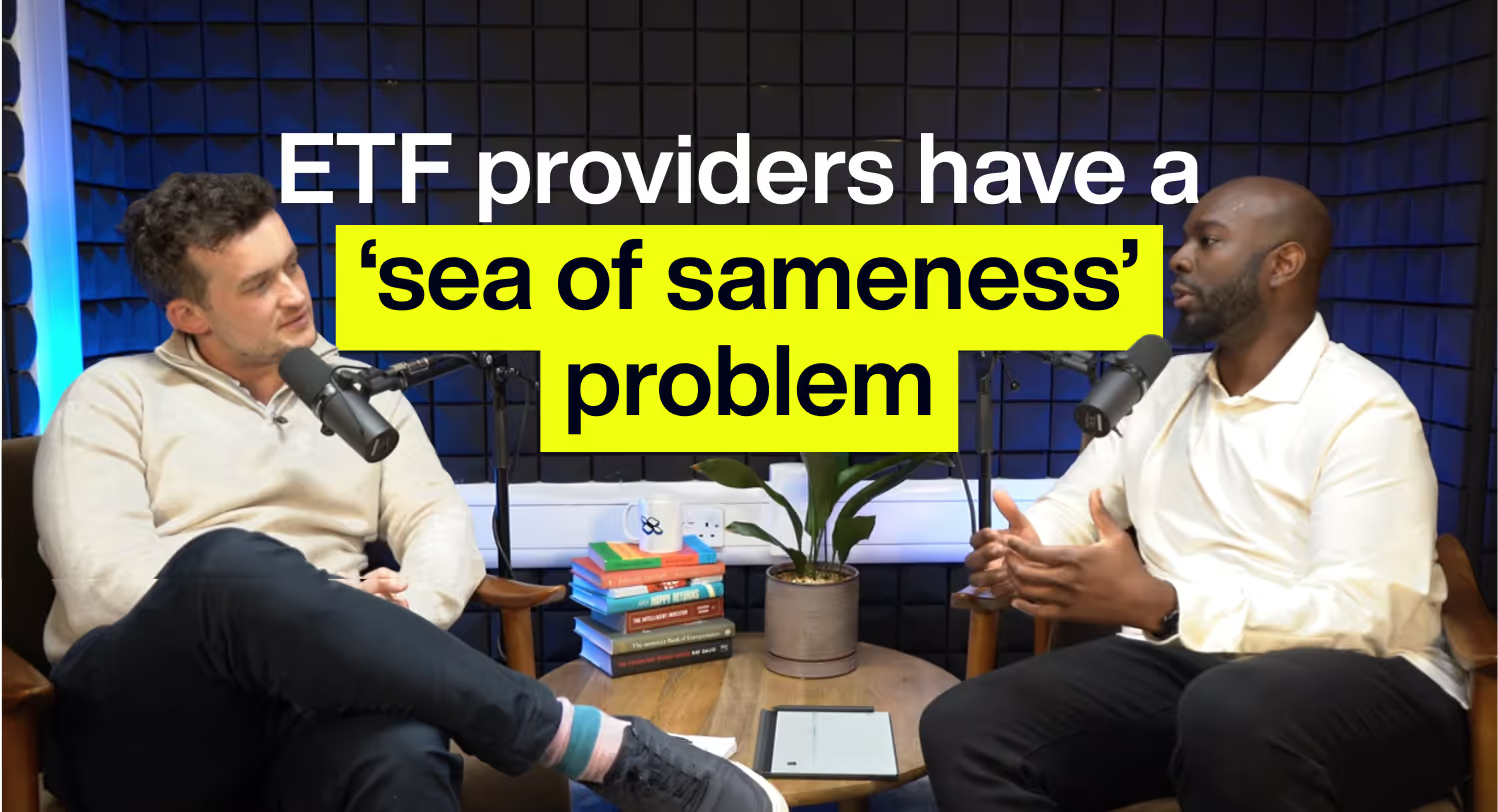
The "sea of sameness" problem
ETF issuers, platforms, and asset managers largely look identical to retail investors. Fraser and Carl explore why that's happening, what the best partners do differently, and where most firms fall short before they've even started.
The great wealth transfer is already here
Three quarters of inheritors churn from their providers. Firms still treating younger investors as a future problem are running out of road — and Fraser explains why the window to build loyalty is now, not later.
What's changing – and what's being missed?
From the FCA's changes to retail investor risk warnings (a significant opportunity most of the industry is too nervous to take) to why this was the worst ISA season on record, this conversation covers the trends reshaping how financial services firms need to think about retail.
Grow your business
with Finimize
Our Partners



Full transcript
Carl: Today I've brought in Fraser Munro. He is our Head of Partnerships. And if there's one thing I think you're going to want to take away from this conversation, it's what makes a good partner for Finimize and how you can use Finimize to be most effective for your organization. As Head of Partnerships, you're responsible for the sales team, the business development efforts, our events, our partner success, and so much more beyond. But I'd love for you to put that in your own words – maybe do it by sharing what your first impression was of Finimize before you joined, and as you got deeper and deeper into the role, how it's evolved.
Fraser: Right. So I'm creeping up on four years here now, which seems wild. My first impression: I was a subscriber, I was a user, I loved the content but my perception was really that it's a newsletter business predominantly. So coming into the commercial side, that means I'm probably charging on with trying to sell ads in a newsletter. What changed is that there were a lot more layers to it. I found that there's a community involved, there's an events business that's prospering, there's a ton of data and insight into this space that we have and that I didn't realize we had. And then there's this entire content partnership, content licensing arm to the business that I wasn't even aware of. So that changed quite quickly, and then flash forward four years, fundamentally, a lot of that has just picked up steam.
Carl: Two things jump out immediately from your answer. One is that we've got tons of data, insights, tactics if you will, and we just need to shout more about that and put more of it into the world. And the other is around industrialization.
Fraser: I feel like we've gone from being cavemen around a fire with a fish on a stick waiting to see what happens, to having an oven and being able to generate warm kippers on demand whenever we're hungry. And that brings me to this question — what do partners or prospects or clients do that sets them up for success with us?
I think the first thing successful partners think about is they don't focus on the product shell first and foremost. It's not: "I want to get in front of retail investors, now let me jump straight to why I'm the best, why I'm the cheapest, why I'm the fill-in-the-blank." It's recognizing that retail investors are actually a more mature group of people than they're probably given credit for in the mainstream press. It's saying: how do I show up regularly? How do I add genuine value? How do I put whatever's happening in the markets into context and use that context to actually show the thought leadership or expertise that I might have? And if you do that on a consistent basis – it sounds like pie in the sky, but when you do have something to say about your product, you've built up the credibility, you've built up the trust, and you can actually land that message at the time that matters, rather than just going straight to the end point.
Carl: You say it's perhaps pie in the sky – I don't think it is. The get-rich-quick thinking is almost the anti-example. Most of the investors we speak to every day are smart enough to know there is no get-rich-quick scheme. But some of the less successful partners think, "Ah, Finimize is the equivalent of a get-rich-quick scheme for getting assets into my vehicle, getting people to use my product, getting leads." As with investing, there is no quick fix. If you're a brand, asset manager, or platform having these conversations – it's not performance marketing. It's not a get-rich-quick scheme.
When we host webinars or events for Finimize members, I always say to the speakers and guests: we want practical, real examples, real takeaways, not theory. So I'm going to hold you to the same standard – give me a case study.
Fraser: A recent one that springs to mind is our work with CoinShares. Big crypto ETP asset manager. From day one, the nice thing was they came in and said, "How do we deliver value on a regular basis?" That's music to our ears. We have an audience, we have a trusted relationship with these members, we want to put out content we're proud of – and they were very much on board with that. So that frame of mind helped from day one.
What that actually looked like in practice was we sat down and produced a bunch of really high-quality educational content and set up a distribution plan around it; an always-on component. But the more interesting and relevant part was using the context of what's happening in crypto markets to not just talk about crypto, but to position the education alongside it. We give people real education founded in what's happening right now.
Then, once we'd built up some trust and credibility, when there was a more timely, opportunistic moment that CoinShares cared about and our users cared about. For example, a couple of weeks ago the ISA rules changed around crypto, so as of April 6th users could no longer invest in crypto in their ISA — the call to action was: do it now, before that date. They'd built up the credibility, educated our users, and when they wanted to land that message, it landed, because they'd done the hard yards and put down the foundations first.
Carl: Three things jump out there. One — no shilling. It's a collaborative educational process, and yes, we want action, and when the time is right, you help partners push towards that. Two — it's all in service of retail investors. We're not going to do anything that puts them in harm's way; we're actively trying to do the opposite. So if you want to come on that journey with us, we'll find a way to make it work. And the third point is around meeting investors where they are. We know there are tons of conversations going on around crypto products: ETPs, direct on-exchange, questions on storage. Let's figure out where the conversation is, figure out how we can be most helpful — whether that's education, insights, a blend of all of the above: tap into the news, bring people along the journey, do it together with CoinShares, and then when there's a deadline coming up or something people need information on in a timely way, we're there.
What kinds of questions do partners ask when they come in the door at Finimize?
Fraser: Right. So bucket one: traditional financial services businesses that want to reach retail. What they're looking to do, and what we try to help them do, is take the playbook they've always used for intermediaries and institutions—the great thought leadership, the great insight, the intelligence they should and could share with retail—and we help them translate it, distribute it in the right channels, in the right places, in the right formats, genuinely adding value and educating the next generation of end investors. That way you avoid the challenge of: why are you any different from any other business?
Carl: Have you ever seen the show Scorpion? Okay, so the setup is: four super geniuses, IQ through the roof, but EQ basically zero. Then along comes a character called Paige;' a lovely regular person but EQ through the roof, relatively speaking. Her job is to be the translation layer between these geniuses and the rest of the world. I feel like what you've described is Finimize being Paige for financial institutions who are high-IQ, low-EQ, at least when it comes to retail investors.
Fraser: Be more Paige.
Carl: Be more Paige. And for partners who are already retail-native, how are you answering their questions?
Fraser: For those guys, it's about sitting down and saying: how are you thinking about your content strategy? What user are you going after? What challenges are they suffering from? What does the current content mix look like? What gaps have you got? And then building that essentially from scratch: taking some things that are either in our channels and off the shelf, or producing things completely from scratch, building the strategy and the playbook, handing it over to them, helping them implement it, and they're off to the races.
Carl: So you've just come back from meeting clients and prospects in the US. What are you seeing out there?
Fraser: Right. So I was in Miami at Future Proof which, apart from the challenge of 25-degree heat while the UK was in snow... A couple of big things stood out. Three, actually.
First, everyone's talking about AI. But the nuance was interesting. It wasn't just "how can I use it internally, how can it make me more effective?" It was: how can I use it to support my own clients? How can I leverage it to produce more, produce better, personalize content?
Second bucket: the rise of retail. This sounds very self-serving, I know, but hear me out. This was predominantly a wealth adviser event. Historically, big asset managers, loads of wealth managers, loads of advisers. It wasn't like that this time. The big ETF issuers, the big platforms... they are waking up to retail. They want to know what the retail dynamics look like, what the playbook is. That's changing the texture of the toolkit they're using.
Third bucket: the ETF boom. I spoke to tons of ETF providers. They know they're in a huge tailwind, they know it's growing, they want to ride that wave. But for them it's more about how they stand out. I'd call it the sea of sameness problem – how does my ETF stand out from the competitor next door? That kept coming up over and over.
Two smaller things I'd add on the rise of retail. One, everyone's talking about the wealth transfer – the generational shift. People are waking up to that, which is super important. The other, more nuanced point that's maybe underlooked: don't sleep on younger investors now, because they actually have more cash than you realize already. They're putting money into the market today.
I've had conversations, even before you joined, sitting in front of wealth managers and asset managers saying, "This is coming and you should be ready for it." The pushback was always, "Yeah, yeah, yeah, it's coming, but it's not here yet." It's here. It's like the doomsday clock – less existential for the human species, but existential for these financial services firms. If someone says "it's coming but we've got time," I just think: you're about to get washed out when the flood starts.
Carl: What are the differences between the US retail investor market and elsewhere?
Fraser: The US retail market is about ten years ahead. They're sitting around the dinner table talking about stocks, talking about portfolios. Everywhere else, places like the UK, we're talking about cash, about savings. For providers trying to serve retail in the US, it feels like pushing at an open door. More people, more mature, they get it. But that also means fiercer competition – they need to work harder to stand out. Elsewhere, it's a different job to be done, more of an open goal, but a slightly different challenge.
Carl: That's a great segue to the recent news around retail investor risk warnings in the UK. What do you make of it, and is our inbox blowing up now that there's a potentially easier avenue to sell to retail?
Fraser: Sort of. The dynamic here is interesting. It feels like this is massive news and people should be scrambling – the floodgates are open a little bit. But the reality is there's a bit of our industry suffering from being scared to go after that first-mover advantage. Everyone sits around, watches what others do, is too scared to step out of line and do something different –hence the sea of sameness problem I mentioned keeps coming up regularly. And in the context of the FCA: I appreciate there's regulatory compliance involved, but when even the FCA is leaning in and saying "we want to make this easier for people to understand," what an amazing opportunity to create something genuinely useful for a change. I think people should be leaning in, pushing the envelope. What do you think?
Carl: I think between this and targeted support, there's basically no excuse.
Fraser: Easier said than done. But if someone comes up against risk warnings or a lack of targeted support as a reason not to take action—and I'm saying this tongue in cheek—the next call should be to their boss. As a customer of these places, as a retail investor, I have literally had to do it all myself. I've been abandoned. I've had no support, targeted or otherwise. Risk warnings have done nothing to help or protect me. I get it: people are covering themselves, they're afraid, they don't want to get in trouble, and they should be responsible. I'm not saying be irresponsible. But it's one less excuse, and I'm sick of the excuses.
Carl: And to build on that, risk warnings is one big part of it. The other is just hiding behind compliance. One thing I've said before is: think about how much good insight goes to die in PDFs in this industry. Tons and tons of waffle and nonsense that just never gets read. I'm a retail investor, I go onto my platform, I'm shopping around, am I really going to read the fact sheet, the KID? I've never read one, frankly. This is the opportunity to change that. The people who lean in, who actually make it engaging and useful and distribute it in the right way, are going to win. The ones who keep doing what they've always done are going to get left behind.
One question that comes up a lot with clients is: "Okay, we'll go into this partnership, we'll produce content together. How do we make sure it's not just another shell, not just another ad, that it's genuinely going to land?" I always love that question when it comes in from partners, because it shows they're thinking about the right things. They're not treating us as a performance marketing channel to trick retail investors, but as a partner to help inform, engage, educate, and retain important clients.
On one hand there's a bit of church and state about it. On the other, because of how we're set up and our mission, it's not that difficult at all. In practice: our assets are our content and our events. Because we're not an investing platform, we're wholly independent. We're not incentivized to make someone do one thing or another — we want to give them the tools to make the best possible decision. And it's all in service of the modern retail investor. Whether that's through our newsletter, our pro research, or the Modern Investor Summit in New York, we need to meet them where they are, give them news, insight, research, help them be their own financial adviser and make more informed investment decisions — and we're going to do that come what may. If you're a partner and you want to be on that journey with us, absolutely, we will work with you. But you don't get to drive the car. You don't get to tell me how I talk to these retail investors that we've spent years talking to and who trust us.
Fraser: The way I describe it internally and externally is: we would never put out content we're not proud of. Our editorial content we're super proud of. Our partner content we're super proud of. They go hand in hand.
Carl: Normally at this point in the podcast I like to ask what's the craziest headline you've seen this week – but I know what yours is, and it's around ISA season. Do you want to share what that was and what you made of it?
Fraser: Sure. "Worst ISA season ever" is the broad headline. My take is that when I look around at the activity from businesses, providers, and platforms, everyone's running the same playbook year after year. We've been bombarded with the same TV ads, the same tube ads—"we're the cheapest," "commission free," "no fees"—and frankly, I think retail is just a bit bored of it. There's been an over-concentration of: let's put all of our marketing budget into this tiny part of the year, bombard people with product messaging and hope for the best. And I think we're letting down retail for the rest of the year because of that.
Instead of putting all your eggs in the ISA season basket, why not show up consistently, add value over the rest of the year, give people context and education — and then yes, when ISA season comes, you can put some eggs there, but you'll have done the heavy lifting. It becomes a natural next step for a retail investor to say, "Right, now I'm going to sort out my ISA."
Carl: I'd make you 100% right on all of that. What I'd add is: if I look at the Modern Investor Pulse data, we ask where people want to invest but don't feel they have enough knowledge — and for the first time ever, stocks was top of that list. Which I frankly think is unforgivable. Yes, we've had volatility around the Middle East and energy, and that might leave some cash on the sidelines. But for investors to be saying it's not complex derivatives or digital assets they're struggling with—it's basic stocks—that means a ton of people haven't done their jobs. And it makes me angry, because we're doing the job for them, we're trying to help retail investors in our corner of the world, but people aren't doing anywhere near enough.
Let's zoom out. We've had, with a couple of blips, a near-enough uninterrupted bull market for the last ten years, give or take. Pandemic, 2022, a little bit around AI in various pockets, a little bit around the Middle East — but otherwise, an uninterrupted bull market. You haven't had to know very much about stocks to make money investing in them. You just buy the index, close your eyes, the money machine goes brrr, stocks go up. That's been the playbook. So instead of fixing the roof while it's sunny, platforms have sat on their hands and not done anything to back up the education, build the library, develop the muscle to flex when things get tricky.
Fraser: And now, instead of building that muscle and solving that problem, they're running the ISA playbook as you described, and handwaving at areas that might be under pressure – like private credit, or AI SaaS apocalypse catastrophizing. Four percent of retail investors are in private credit – don't get me wrong, I want those 4% to be okay. But 60% are in stocks. That's where you need to spend the energy.
Carl: I'll get off my soapbox. Talking about products, providers, doing things differently: the Finimize Awards: how's it all going?
Fraser: Really exciting times. The votes are rolling in by the truckload. By the time anyone's watching or listening to this, we'll probably have done the first cut of the data to finalize the awards. Just as a reminder — what we're doing that's unique is getting people's views on the platforms and products they use, and then allowing the data to shape the awards. Once we have those results, we'll continue to collect data, shut off the survey, and be in touch with winners.
There's tons of interest from sponsors as well, because—as I said earlier—we serve retail investors. If you want to be on that journey, show that you're on their side. There's a lot of sponsorship opportunity here, and we're having those conversations.
Carl: I think we should talk about the elephant in the room with the sponsorship. What's your traditional award setup? You pay to enter, you pay to influence. We're doing none of that. There is still a commercialized opportunity here. What that looks like in practice is we're not going to announce winners based on who pays or doesn't pay. You can be on the side of retail investors, you can license an award that you win. We're also putting on a really exciting event in June where we'll get leading industry professionals together to talk retail, network, and learn. They're going to understand why people win and why they don't. The data is driving us, and the data will show why somebody wins – is it because they're mobile-first? Is it because their customer service is amazing?
My favorite stat here: if you look at what US modern investors care about and map it to the UK, mobile-first is really important here in the UK; stateside, less so. So if you're going to crack the US, you don't necessarily need to lead with mobile-first.
Fraser: And one more sneak peek from the data: everyone in this industry is shouting about fees, about being commission-free. But that's not actually what people care about. They want ease of use. They want mobile-first. So instead of everyone shouting from the rafters about being the cheapest – make the product experience better, and then maybe shout a bit more about that.
Carl: It comes back to that point you made earlier about ISA season – everyone follows the same playbook. With regulation and risk warnings, everyone wants to stay in line, nobody wants to stick their neck out. One guy over there shouts about fees, the next one shouts about fees. Or, you could do something different. Something that matters. But it's playbooks, playbooks, playbooks.
Fraser: It's like that Spider-Man meme. Everyone just pointing at each other.
Carl: Exactly. Fraser, this has been great. Thank you so much. I promised deep insight into the partners we work with, how we work with them, and why... and I think you've delivered.
Fraser: Thank you. Happy to do it again.